
Ingenuity Swing ‘n Go Portable Swing
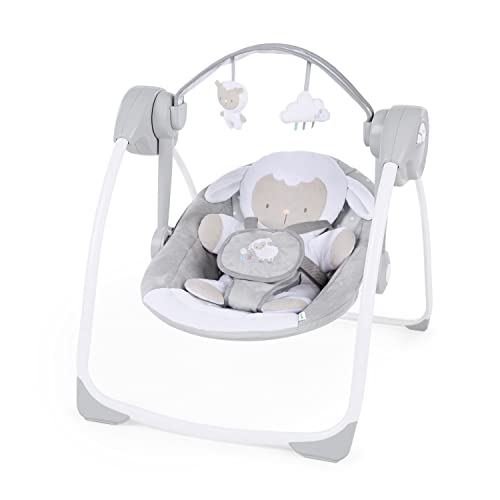
We designed the Swing ‘n Go to be your go-anywhere soothing solution. This compact baby swing folds flat in seconds, weighs less than seven pounds, and tucks into a carry bag for easy transport between rooms or on trips to grandma’s house.


The SlimFold frame is the core of what makes the Swing ‘n Go so packable. You press two release buttons on either side of the frame, lift the seat, and the legs collapse inward until the entire unit lies flat. The folded footprint measures roughly 26 inches long by 8 inches wide—small enough to slide under a bed or stand upright in a coat closet.
WhisperQuiet motor and five swing speeds
Our WhisperQuiet drive uses a brushless DC motor and precision gears to eliminate the grinding or humming sounds common in budget swings. You control speed with a rotary dial on the motor housing; settings range from a barely perceptible glide to a steady arc that covers about 50 degrees.
Parents of newborns typically start at speed two or three to mimic the gentle rocking of arms. As babies grow and enjoy more stimulation, speeds four and five provide a brisker sway. The motor draws four D-cell batteries or plugs into a wall outlet via the included AC adapter, so you’re never stuck mid-nap if batteries run low.
Recline positions and weight capacity
The seat back adjusts between two angles: a near-flat recline for newborns who lack neck control and a more upright position once your baby can hold their head steady. You shift between angles by squeezing a release lever under the seat and tilting the backrest forward or back until it clicks.
Safety and size limits
The Swing ‘n Go is rated for infants 5.5 to 20 pounds. Most babies outgrow the swing by six or seven months when they begin sitting unassisted and prefer floor play. We use a five-point harness with adjustable shoulder straps to secure babies at the chest and between the legs. Always follow the manufacturer’s weight guidelines and stop using the swing once your child can climb out or exceeds the maximum.
What makes this swing travel-ready
More portable swings and convertible seating



Customer reviews


Common questions about the Swing ‘n Go
The swing weighs 6.8 pounds without batteries. When you add four D-cell batteries for the motor and two more for the vibration, total weight climbs to around 8 pounds. The included carry bag adds another few ounces but has a padded shoulder strap to make transport comfortable.
Yes. The swing runs on four D batteries installed in the motor housing, so you can use it anywhere without an outlet. Battery life varies by speed—expect 60 to 80 hours of use at medium speed. The AC adapter is included as a backup to save on battery costs when you’re near a wall socket.
The maximum weight is 20 pounds, and the minimum is 5.5 pounds. Most babies reach 20 pounds between five and seven months. Once your child exceeds the limit or can sit up and climb out unassisted, discontinue use and transition to a stationary activity seat or floor play.
All fabric pieces detach and are machine washable. Pull the seat pad off the plastic shell by lifting the edges, unfasten the head support, and remove the harness covers by sliding them off the straps. Wash in cold water on gentle cycle and air dry to prevent shrinkage.
Unfolding takes about ten seconds: lift the frame until the legs lock into place, then snap the seat onto the mounting brackets. Folding is equally quick—press the two side releases, remove the seat, and collapse the legs. With practice you can do both one-handed while holding your baby.
The toy bar clips onto fixed brackets on each side of the frame. You can remove it entirely by squeezing the clips and pulling the bar away, but you cannot adjust its height or angle. The two plush toys are sewn onto the bar and do not detach individually.
The swing is stable on both carpet and hard floors. The rubber feet prevent sliding on tile or hardwood, and the wide base keeps it from tipping on medium-pile carpet. Very thick or shag carpet may dampen the swing motion slightly, but the motor compensates by maintaining consistent speed.